Luminous Flux vs. Illuminance
These are two important concepts that many users are unfamiliar with. However, they can be decisive when choosing the right light bulb or light fixture. What’s more, they can also improve your work performance and spare you the hassle of eye strain. Let’s take a closer look at them.
Luminous flux
Answer to the crossword puzzle question. What is the unit of luminous flux? Lumen (lm). Simply put, this term refers to the amount of light energy that a light source is capable of emitting into its surroundings—that is, in all directions.
As a rule, the luminous flux is listed on the light bulb’s packaging and is one of the key indicators. Since this is a somewhat complex measurement, it’s important to pay close attention when making a purchase. Some manufacturers misrepresent these figures. For our LED bulbs, we show the average value, which has been verified in a laboratory.
Even if you decide to go with an LED bulb, individual products can still vary. Technology is constantly advancing, and some older models fall far short of the luminous flux values achieved by the most modern versions. Every light bulb has a limited lifespan. If you choose a cheaper option, the luminous flux may be 70% lower by the end of its lifespan than it was when you bought it. The relationship to power consumption is also important. This parameter is called luminous efficacy and indicates how many lumens a light source emits per 1W of power consumption. Simply put, this metric tells you how good a light bulb is. A filament LED bulb achieves values of up to 130 lm/W.
In terms of power consumption, the filament type ranks among the top performers. The 6.5W version can produce a luminous flux of up to 806 lm, which is equivalent to a traditional 60W incandescent bulb.
Illuminance
The luminous flux per unit area. This is how illuminance is defined. In other words, it is the ratio of luminous flux (lm) to area (m). The unit is the lux (lx).
Determining the exact value of luminous flux is very complicated. It depends on the distance of the object from the light source, the angle at which the light strikes it, and the reflection from surrounding objects. Furthermore, these objects may absorb some of the light and reflect only a fraction of it. If we still want to determine the exact value, we need to use a lux meter or specialized software. In most cases, however, we have to rely on our subjective perception.
Recommended Values for Specific Types of Work Activities
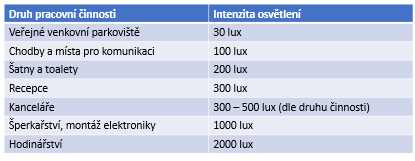
Source: BOZP.cz
Why Intensity Is Important
Poor lighting reduces work performance by up to 30%. A lack of high-quality light can significantly impair our ability to work and lead to fatigue, discomfort, or eye strain. It can be said that lighting is part of the workplace culture. Not only a lack of light but also excessive intensity can have negative effects.

Source: ČSN 36 0452 Artificial Lighting in Residential Buildings
This online shop stores cookies to help it function properly. By using our services you agree to their use.